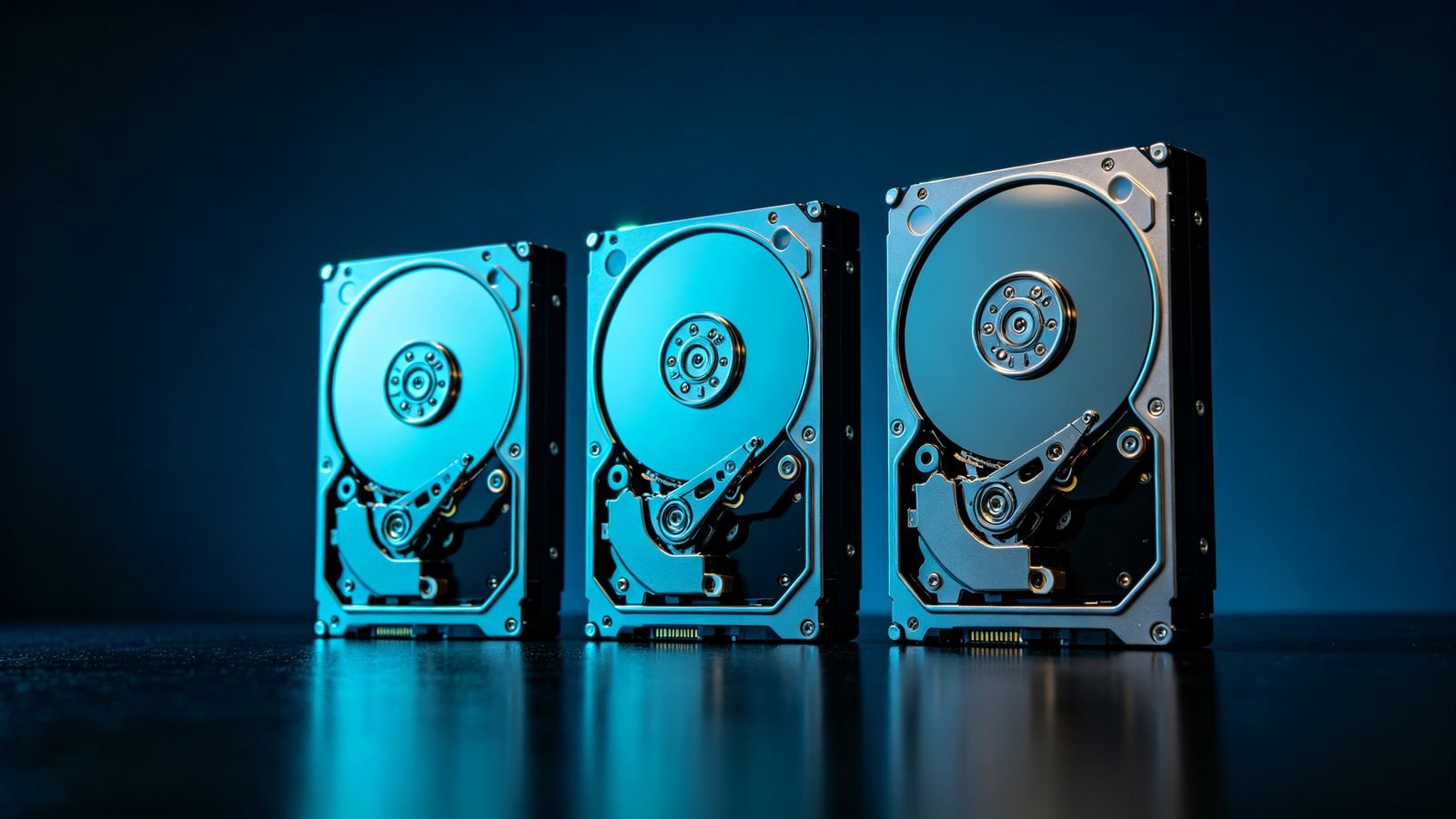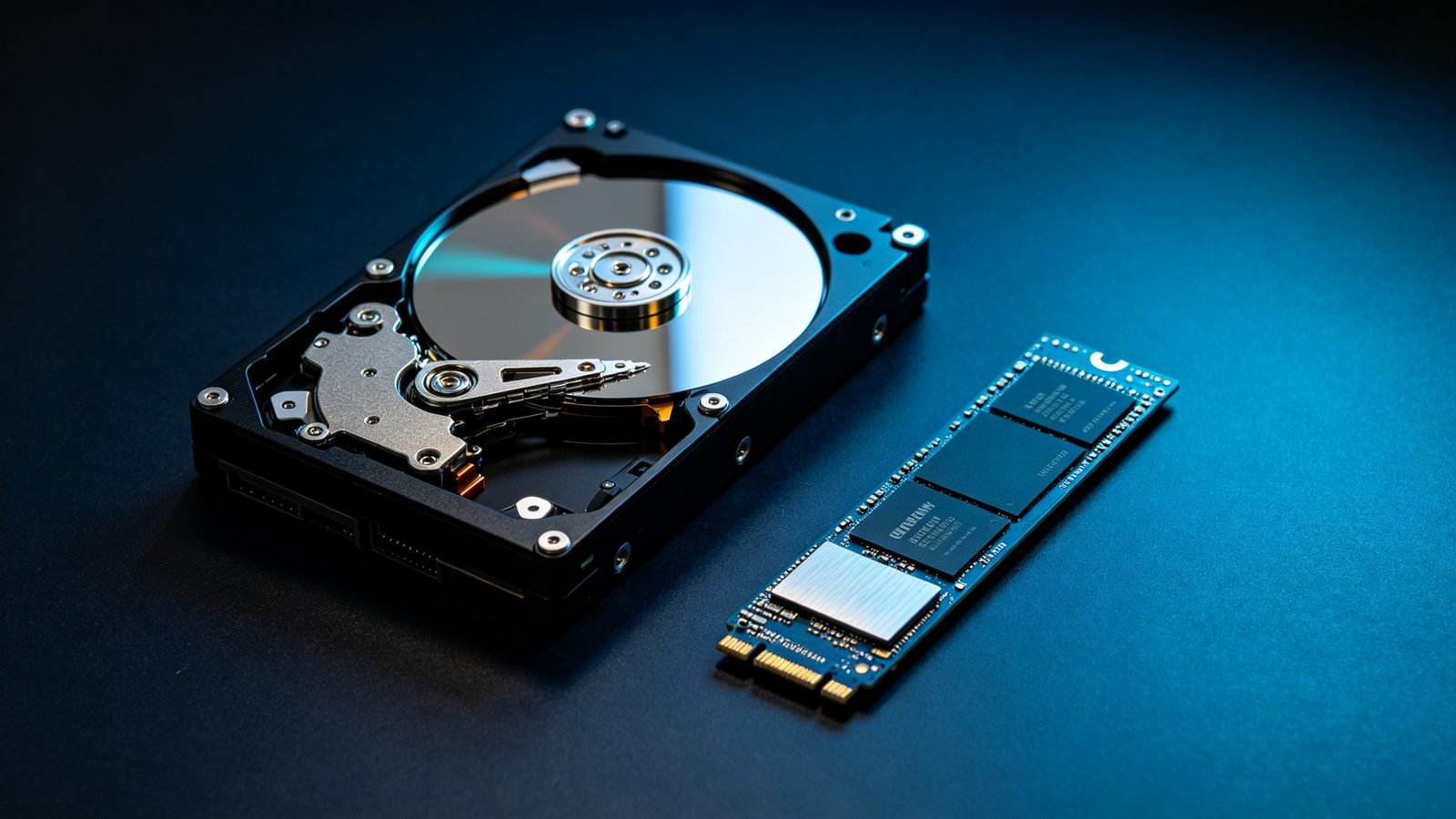


For years, hard drive capacity grew by shrinking the magnetic grains that store each bit and packing the tracks closer together. That process ran into a physical wall. HAMR — heat-assisted magnetic recording — is how the industry got past it, and why the largest drives available today hold as much as they do.
The wall: why smaller grains stop working
Every bit on a hard drive platter is stored as the magnetic orientation of a small region of material — a cluster of grains that all point the same way. To increase capacity, you shrink those regions so more of them fit per square inch.
That is easy to do right up to the point where it is not. As grains get smaller, they hold less magnetic energy, and thermal energy at room temperature starts to become comparable to it. The bit can flip on its own, with no external cause. This is the superparamagnetic limit, and once grains reach it, the data simply does not stay written.
There are only two ways out. Make the material harder to magnetise — higher coercivity — which preserves data but also makes it harder to write with a conventional head. Or improve the media geometry. HAMR does both, by changing the temperature at which writing happens.
The core idea: write while hot, keep when cold
Magnetic materials become easier to magnetise as they heat up. Push a material past its Curie temperature and its magnetic resistance collapses almost entirely — it will accept whatever orientation a nearby field imposes. Cool it again and the orientation sets, now locked in by the full coercivity of the cold material.
HAMR exploits exactly that window. The drive briefly heats a tiny spot on the platter to several hundred degrees Celsius, writes to it while it is soft, and lets it cool within nanoseconds as the platter spins away from the heat source. The recording material can then be formulated with very high coercivity — stable for decades at room temperature — without that high coercivity blocking the write.
The spot is small and the heating brief, which is what keeps the approach practical: neighbouring bits are not disturbed, and the platter is not meaningfully warmed overall.
The three pieces that have to work together
- A nanoscale heat source. The write head carries a plasmonic near-field transducer — a tiny metallic structure that concentrates laser energy into a spot far smaller than the wavelength of the light itself. Without this, the heated region would be far too large to be useful.
- A high-coercivity medium. The platter uses an ordered iron-platinum alloy rather than the cobalt-based alloys of conventional media, engineered to hold its magnetisation at very small grain sizes and to survive repeated heat cycles.
- Nanosecond thermal control. The laser pulse, the write field and the cooling rate all have to line up within a window measured in nanoseconds, while the platter is moving at speed and the head is flying nanometres above it. This is the manufacturing and reliability challenge that took the industry years to solve.
What it changes on a datasheet
| Metric | Conventional recording | HAMR |
|---|---|---|
| Practical capacity ceiling | Plateaus once grains hit the thermal limit | Extends well beyond, into the 30TB+ range and upward |
| Areal density growth | Slowing to a crawl | Reopens headroom for continued growth |
| Media stability | Degrades as grains shrink | Preserved by high-coercivity material |
| Manufacturing complexity | Mature, well-understood | Significantly higher; supplier capacity is the constraint |
HAMR also compounds with other techniques. Combine it with shingled recording and the density gain stacks, which is why the top of a manufacturer’s capacity range tends to arrive as a combination of both.
What it means when you are buying
New recording technology always follows the same commercial path, and knowing the shape of it helps avoid overpaying:
- Early supply is scarce and priced for density. The first drives to a new capacity point command a premium, because the buyers who need a specific density per slot — hyperscalers, dense arrays with fixed bay counts — will pay for it.
- Cost per terabyte takes time to win. A HAMR drive at the top of the range is not, at launch, the cheapest way to buy a terabyte. It is the cheapest way to buy a terabyte in one slot. Those are different problems.
- Mature capacity points keep improving value. While flagship capacities climb, the volumes in the tier below continue to benefit from learnt yield and scale, and the refurbished market around them matures too.
- Compatibility deserves a check. New capacity points sometimes need newer controller firmware or updated qualified-drive lists. Confirm against your array vendor before ordering in volume.
The decision, in practice
- If your constraint is bay count or rackspace — a fixed chassis you cannot expand — paying for density is rational. The premium buys capacity you physically cannot get otherwise.
- If your constraint is budget for capacity — the goal is the lowest cost per terabyte — the mature mid-to-high capacity band is still where the best economics sit.
- If you are mid-refresh and 24–28TB already covers your projection — there is no reason to chase the newest tier. Buy the capacity that solves the problem, then watch the price curve rather than leading it.
Conclusion
HAMR is the answer to a real physical limit, and it is the reason hard drive capacity kept growing when the old approach ran out of road. It does not make the previous generation obsolete — it opens a new top end above it.
The buying question is not whether the technology is impressive. It is whether your constraint is density or budget. Answer that, and the right capacity point picks itself.